Get ready for fall season!
The Fall 2026 season runs Aug. 31 to Nov. 8.
iProSkills Academy is now using PlayMetrics as our official club management platform. From now on, all player registrations, schedules, and program information will be managed through PlayMetrics.

Dear iProSkills Families,
We are excited to officially open registration for the 2026–2027 iProSkills Academy season.
As our club continues to grow, we remain committed to providing a professional, development-focused environment for all players while continuing to improve the overall experience for our families and teams.
For the upcoming 2026–2027 season, our programs will continue to include:
• Fall, Winter, and Spring training • League participation (YSSL / IWSL/NISL )
• Professional coaching and player development
• 2x or 3x training sessions per week depending on team level
In addition, we are excited to announce that beginning this season:
• 1 tournament will now be included during the Fall season
• 1 tournament will now be included during the Spring season
This addition is part of our continued effort to provide more competitive opportunities and a more complete developmental experience for our players.
As part of these improvements, and due to increasing league, facility, tournament, referee, and winter training costs, there will be an adjustment to team fees for the 2026–2027 season. These updates allow us to continue providing a high-quality training environment and competitive opportunities throughout the year.
Travel program requires year-round commitment. Playing only in Fall, Winter or Spring is not an option! Rental contracts, coaches salaries, league fees and operational expenses are all covered by the membership fees hence the importance of the yearly commitment.
2026–2027 TEAM FEES:
Pre-Travel Program • U7 BOYS AND GILRS August 1, 2019 – July 31, 2020: $1,500
Youth Travel Programs BOYS AND GIRLS
• U8–U10 | August 1, 2016 – July 31, 2019: $2,100
• U11–U14 | August 1, 2012 – July 31, 2016: $2,400
High School Boys Programs (Winter/Spring)
• U15–U18 | August 1, 2008 – July 31, 2012: $1,600
High School Girls Programs (Fall/Winter)
• U15–U18 | August 1, 2008 – July 31, 2012: $1,600
A separate $300 registration fee is due at the time of registration.
Uniforms require additional cost! All new players are required to purchase new game uniforms(set of 3 game uniforms $220)
Flexible installment payment plans will also be available for families.
We sincerely appreciate your continued trust and support as we continue building a positive, competitive, and development-focused environment for all iProSkills Academy players.
If you have any questions regarding registration, payment plans, or team placement, please do not hesitate to contact us.
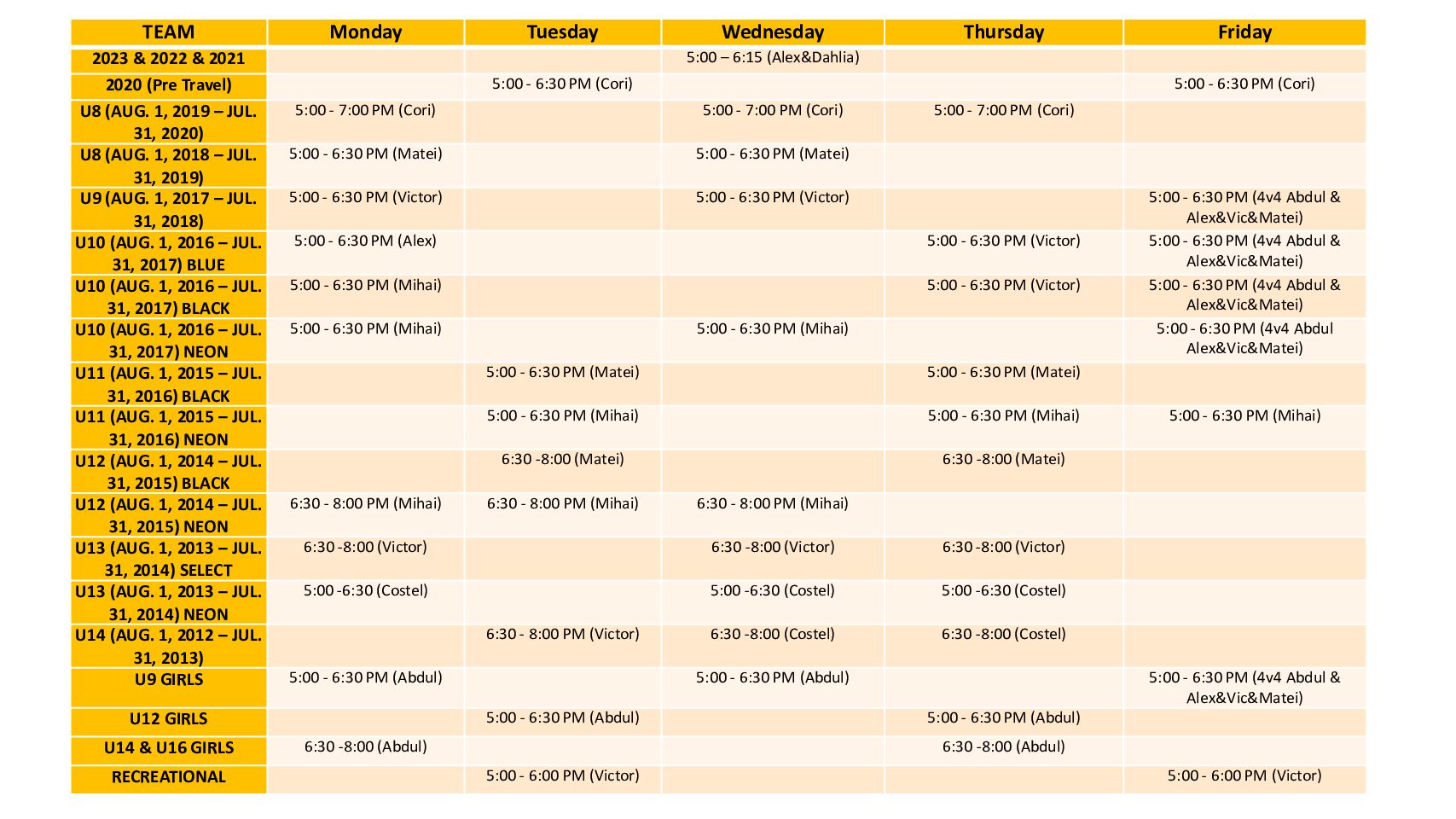
Fall 2026 Training Schedule
U.S. Soccer Age Matrix: 2026–27 Season
Beginning with the 2026–27 season, U.S. Soccer Federation is implementing an updated age-group matrix that affects how players are grouped for league and club play across the country.
The change aligns youth soccer more closely with school-year cohorts, rather than strict calendar-year birthdates. For families, this means some players may move into a different age group than expected, even if their birth year has not changed. iProSkills will follow up with families of players who may be impacted.
| Age Group | Birthdate Range (2026–27) |
|---|---|
| U-6 | Aug. 1, 2020 – July 31, 2021 |
| U-7 | Aug. 1, 2019 – July 31, 2020 |
| U-8 | Aug. 1, 2018 – July 31, 2019 |
| U-9 | Aug. 1, 2017 – July 31, 2018 |
| U-10 | Aug. 1, 2016 – July 31, 2017 |
| U-11 | Aug. 1, 2015 – July 31, 2016 |
| U-12 | Aug. 1, 2014 – July 31, 2015 |
| U-13 | Aug. 1, 2013 – July 31, 2014 |
| U-14 | Aug. 1, 2012 – July 31, 2013 |
| U-15 | Aug. 1, 2011 – July 31, 2012 |
| U-16 | Aug. 1, 2010 – July 31, 2011 |
| U-17 | Aug. 1, 2009 – July 31, 2010 |
| U-18 | Aug. 1, 2008 – July 31, 2009 |
| U-19 | Aug. 1, 2007 – July 31, 2008 |
| U-20 | Aug. 1, 2006 – July 31, 2007 |
What is the new cutoff?
Under the updated system, age groups are determined by a school-year window:
-
Aug. 1 – July 31
-
Players are grouped with peers they are most likely to attend school with
-
This replaces the previous Jan. 1 – Dec. 31 calendar-year model
Why did U.S. Soccer make this change?
According to U.S. Soccer, the shift is intended to address long-standing concerns in youth development:
1. Competitive balance
The calendar-year system often favored players born earlier in the year, creating physical and developmental gaps at younger ages.
2. School and social alignment
Grouping players by school year keeps teammates together in classrooms and on teams, improving retention and social development.
3. Long-term player development
Research cited by U.S. Soccer shows athletes are more likely to stay engaged—and develop at appropriate rates—when competition better matches physical and emotional maturity.
4. Consistency across youth sports
Many U.S. youth sports already use school-year cutoffs, reducing confusion for families with multi-sport athletes.
iProSkills Academy official merch is here
Order Adidas quarter zips, hoodies and more through our online store.